Thursday, January 27, 2022

Section 1983 Liability for Police Chase Reviewed by Eastern District Court


In the case of McKenna v. Wolk, No. 2:18-CV-03746-MSG (E.D. Pa. Dec. 29, 2021 Goldberg, J.), the court granted in part and denied in part a Motion for Summary Judgment filed by a Defendant police officer and a city Defendant in a Plaintiff’s §1983 unreasonable seizure and excessive force claim.

According to the Opinion, the officer was involved in a police chase and allegedly caused a collision with a dirt biker that the officer was pursuing.

In its decision, the court found that the Plaintiff had presented sufficient evidence for a jury to conclude that a seizure had occurred. The court also felt that a reasonable jury could also conclude that the officer used excessive force under the circumstances.

However, relative to the claims against the Defendant city, the court found that the Plaintiff did not sufficiently point to a custom of violent conduct on the part of that Defendant.

As such, the Motion for Summary Judgment was granted in part and denied in part.

Anyone wishing to review a copy of this decision may click this LINK.


Source: “Digest of Recent Opinions.” Pennsylvania Law Weekly (Jan. 20, 2022).

Source of image:  Photo by Scott Rodgerson on unsplash.com.

Wednesday, January 26, 2022

Employer Who Furnishes Alcohol At An Employee Event Considered to be a Social Host -- No Liability for Later DUI Accident By Employee


In the case of Klar v. Dairy Farmers of America, Inc., No. 1280 WDA 2020 (Dec. 17, 20221 Pa. Super. Olson, J., Nichols, J., and Musmanno, J.) (Op. by Olson, J.), the Pennsylvania Superior Court affirmed the entry of judgment on the pleadings in favor of the Defendant.

For a summary of the trial court's opinion that was affirmed (and a Link to that decision), please see this Tort Talk Blog post HERE.

The trial court had entered judgment against the Plaintiff and in favor of an employer in a case in which the trial court had ruled that an employer who collects contributions for a social event was still considered to be a social host with respect to any liability claims under the Dram Shop Act. Based upon this ruling, the trial court dismissed the Plaintiff’s negligence claims against the employer.

According to the Superior Court's Opinion, the Pennsylvania was injured in a motor vehicle accident when the vehicle operated by the Defendant driver struck the Plaintiff’s motorcycle.

The Defendant driver was an employee of Dairy Farmers of America. That employer had sponsored a golf outing and encouraged its employees to attend. The employees made a monetary contribution to offset the cost of the greens fees, food, and alcohol. After collecting the contributions from the employees, the employer paid for the event in its entirety.

The Plaintiff alleged that, at the event, the Defendant driver consumed an amount of alcohol that raised his blood alcohol level beyond the legal limit. The Defendant driver then proceeded to drive and was involved in the accident with the Plaintiff.

The Plaintiff sued the Defendant driver as well as his employer under negligence claims. The employer filed a Motion for Judgment on the Pleadings arguing that it was not liable under the Dram Shop Act because it was a social host.

The Pennsylvania Superior Court ruled that an employer who furnished alcohol at a sponsored employee social event was not a licensee or other party subject to per se Dram shop liability but was instead a social host who could not be held proximately liable for an employee causing an alleged drunk driving accident.

Anyone wishing to review a copy of this decision may click this LINK.


Source: “Digest of Recent Opinions.” Pennsylvania Law Weekly (Jan. 4, 2022).


Source of image:  Photo by Steven Shircliff on unsplash.com.

Are You Willing To Help Out as a Mock Trial Juror? (Virtual)


Monday, January 24, 2022

The Benefits of Participating in the Mock Trial Competitions as a Juror


The local District High School Mock Trial Competitions are set to commence next week on February 1, 2022.  Hoping you might please consider serving as a juror or a judge for the competitions which will be virtual.  The competitions typically start at 6 p.m. and, given that they are being held virtually, you can participate as a juror from the comfort of your own home.

Here is a LINK to the Tort Talk post on my previous article from the Pennsylvania Lawyer magazine that lists the many ways that attorneys can benefit from their participation in the PBA's High School Mock Trial competition as a juror or as an Attorney Advisor to a local high school.

Hoping you might please give the article a read to consider the benefits of this participation. 

Here is a LINK to the Tort Talk post on  my previous article that appeared in the Pennsylvania Law Weekly regarding the efforts to get the Pennsylvania Supreme Court to change the CLE/CJE Rules to allow for attorneys and judges to secure credits for participation in high school Mock Trial competitons as jurors and judges.

To date, those CLE Rules have not changed.  As it stands now, you can still secure CLE credits for taking exercise classes or for an hour of meditation, but not for your participation as a juror or a judge in a Mock Trial competition.  Go figure.  Ridiculous.

Please note that the high school kids who participate in Mock Trial spend hours and hours crafting and practicing their case presentations in the case this year which involves a murder trial.  Hoping you might consider volunteering as a juror so that we can fill the virtual jury boxes for the kids.  Thank you.

To sign up to serve as a juror for the Lackawanna County Mock Trial competition, please email Attorney Katie Nealon at knealon@munley.com or Kaitlyn McDonough at the LBA at kmcdonough@lackawannabar.org.

No Duty on UIM Carrier to Advise Plaintiff of Change in the Law


In the case of Devine v. Geico General Ins. Co., No. 5:21-CV-02679-JMG (E.D. Pa. Jan. 7, 2022 Gallagher, J.), the court addressed claims of breach of contract, breach of the implied covenant of good faith and fair dealing, statutory bad faith claims and claims of a violation of the Unfair Trade Practices and Consumer Protection Law (UTPCPL) in a UIM case in which the household exclusion was relied upon by the carrier.

At issue before the court was a Motion to Dismiss the Complaint filed by the carrier. This motion was largely based on statute of limitation arguments.

The court found that the event triggering the running of the statute of limitations was the original denial of the claim and not a later refusal to pay after a renewed demand was submitted by the Plaintiff.

The court applied the four (4) year statute of limitations on the contract claims, including a breach of the covenant of good faith and fair dealing. The court found that these claims were barred based upon the allegations on the face of the Complaint.

The court also noted that the statutory bad faith claims asserted by the Plaintiff was subject to a two (2) year statute of limitations. As such, those claims were also found to be time-barred.

Relative to the Plaintiff’s bad faith claims, the court found that the Plaintiff had failed to allege any specific facts to support these claims, even if they were not barred by the statute of limitations.

Notably, the Plaintiff also asserted that the carrier had violated the UTPCPL because the carrier allegedly breached a duty to notify the insured that the Pennsylvania Supreme Court had changed the law regarding the household exclusion by way of the Supreme Court’s decision in the case of Gallagher v. Geico.

The court in this Devine case found “no support in Pennsylvania law for such an extraordinary duty” as alleged by the Plaintiff.

Judge Gallagher also noted in the Devine case that the “Courts that have addressed the issue of whether a company has a duty to inform its customers of a change in the law have uniformly held that no such duty exists.”

Given that the court found that any effort to amend their Complaint would be futile, the Complaint in this matter was dismissed with prejudice by the court.

Anyone wishing to review a copy of this decision may click this LINK.  The companion Order can be viewed HERE.

I send thanks to Attorney Lee Applebaum of the Philadelphia law office of Fineman Krekstein & Harris for bringing this case to my attention. Please check out Attorney Applebaum’s excellent blog entitled The Pennsylvania and New Jersey Bad Faith Case Law blog.

Friday, January 21, 2022

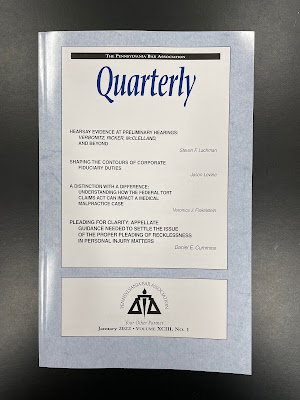
ARTICLE: PLEADING FOR CLARITY: Appellate Guidance Needed To Settle The Issue Of The Proper Pleading of Recklessness in Personal Injury Matters


Here is a LINK to my article entitled "PLEADING FOR CLARITY: Appellate Guidance Needed To Settle The Issue Of The Proper Pleading of Recklessness In Personal Injury Matters" which was just published in the January 2022 edition of The Pennsylvania Bar Association Quarterly.

Note that the article contains a detailed Scorecard of decisions handed down by the various county courts of common pleas all across the Commonwealth of Pennsylvania in recent years, which may prove helpful for your research on this issue, depending upon which county you are litigating the issue.

I send thanks to Professor Robert Rains, the Editor of the PBA Quarterly for his excellent editing of the article into a better article and for selecting this piece for publication.

Also thanking Phyllis Pilla for her editorial assistance with the article as well.

Anyone desiring a copy of any of the cases referenced in the article may contact me at dancummins@CumminsLaw.net.


Wednesday, January 19, 2022

Court Finds No Personal Jurisidiction Over Cruise Line Where Plaintiff's Injury Did Not Occur In Pennsylvania


In the case Knox v. Seven Seas Cruises, No. 525, August Term 2020 (C.P. Phila. Co. Aug. 21, 2021 New, J.), the trial court issued a Rule 1925 Opinion requesting the Superior Court to confirm the trial court’s decision to dismiss the case for lack of personal jurisdiction.

According to the Opinion, the lawsuit between the Plaintiff and the cruise line grew out of a dispute over the Plaintiff’s request for a cash refund. 

The Plaintiffs filed suit in Philadelphia County on the claims presented and asserted that the Pennsylvania trial court had specific jurisdiction because the financial harm that the Plaintiff allegedly suffered related to the cruise line’s contacts in Pennsylvania, specifically, the company’s solicitation of the Plaintiffs’ business.

The cruise line filed Preliminary Objections raising the issue of personal jurisdiction.

The court ruled that, while the Defendant solicited business from Pennsylvania, including the Plaintiffs’ business, the court lacked specific personal jurisdiction over this foreign corporation because the allegedly injury-causing incident involving the Defendant did not occur in this State of Pennsylvania. The court otherwise found that the combination of the Plaintiffs’ Pennsylvania residency and the Defendant’s solicitation of business in Pennsylvania was not sufficient to confer personal jurisdiction over the Defendant.

As such, the trial court requested that the Superior Court affirm its decision on appeal.

Anyone wishing to review a copy of this decision may click this LINK.

Source: “Digest of Recent Opinions.” Pennsylvania Law Weekly (Dec. 21, 2021).